Most Peaceful Destinations to Spend Your New Year in Himachal
If your idea of celebrating New Year’s Eve involves roaring DJ stages on the Mall Road, bumper-to-bumper taxi lines, and waiting forty minutes for a table at a cafe, head straight to central Manali or Shimla for a new year trip to himachal.
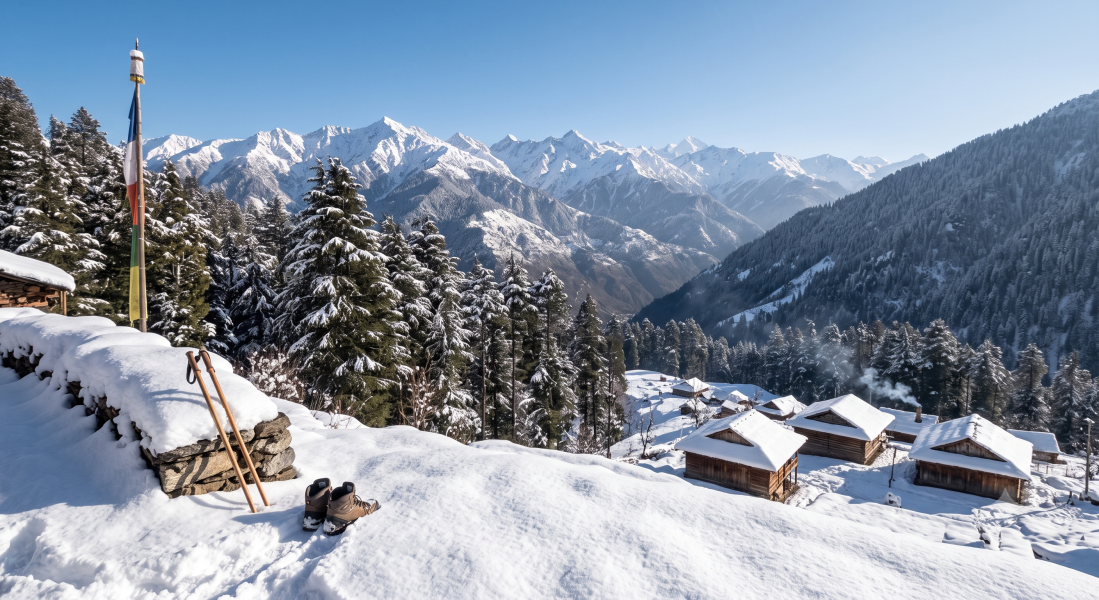
If you want absolute silence, clean starlit skies, and waking up on January 1st to the sound of wind rustling through frozen pine needles, you need to look elsewhere.
Between December 28th and January 2nd, the main arterial highways of Himachal Pradesh absorb tens of thousands of tourist vehicles. The commercial centers get overwhelmed quickly. Yet, tucked away just an hour or two off the main national highways lie quiet valleys, heritage hamlets, and high-altitude ridges where winter remains tranquil.
What Makes a Mountain Destination Truly Peaceful for New Year's Eve?
A peaceful New Year getaway requires two factors: physical separation from national highway bottlenecks and a community culture centered around homestays rather than high-density hotels.
Towns dominated by massive concrete resorts attract large party groups and late-night bus tours. In contrast, smaller villages built around traditional deodar-and-stone architecture naturally limit tourist density. In these smaller pockets, evenings revolve around wood-fired iron stoves (bukharis), home-cooked local meals, and early nights under heavy quilts.
5 Peaceful Himachal Spots to Ring in the New Year
1. Jibhi and Shoja (Banjar Valley)
Located just beyond the Aut tunnel on the road toward Jalori Pass, Jibhi and its higher neighbor Shoja offer dense cedar forests and tumbling mountain streams without the commercial sprawl of the Kullu valley.
While Jibhi’s lower market area has grown more popular over recent years, stepping back into the villages of Tandi or climbing higher toward Shoja puts you in pristine winter terrain. Shoja sits at nearly 2,700 meters, meaning it regularly catches snow well before the lower valleys.
-
The Vibe: Cozy wooden treehouses, quiet forest trails, and easy day walks to frozen waterfalls.
-
Winter Logistics: The road from Aut to Banjar is generally well-maintained, but the steep climb from Jibhi up to Shoja gets slick with morning ice after snow. Ensure your driver is comfortable with steep mountain gradients.
2. Naggar (Kullu Valley)
Sitting along the quieter eastern bank of the Beas River, Naggar was once the ancient seat of the Kullu kingdom. It remains remarkably grounded and relaxed, despite being only twenty kilometers south of bustling Manali.
Naggar lets you enjoy the sweeping snow-covered panoramas of the upper Pir Panjal range while bypassing the chaotic traffic jams of the main highway. You can spend your days exploring traditional Kathkuni wood-and-stone architecture, visiting the historic Naggar Castle, or walking along peaceful trails winding through deodar groves.
-
The Vibe: Slow village life, heritage art galleries, authentic wood-fired cafes, and crisp winter sunshine.
-
Winter Logistics: Because Naggar sits at roughly 2,050 meters on a wide, sunlit ridge, roads here remain open and accessible throughout winter, with far less ice buildup than high-altitude passes.
3. Narkanda and Kotgarh (Upper Shimla)
Most travelers heading toward Shimla stop right around Kufri or Fagu, leaving Narkanda—two hours further northeast on the Hindustan-Tibet road—far quieter.
Perched at 2,700 meters and flanked by dense forests of spruce and fir, Narkanda is one of the earliest inhabited spots in the lower ranges to receive deep snowfall in December. If you venture another fifteen minutes down into the apple bowl of Kotgarh, the hills open into serene valleys dotted with quiet family-run estate homestays.
-
The Vibe: Crisp mountain air, deep snow drifts, quiet apple orchards, and sweeping views of the greater Himalayan snowline from Hatu Peak.
-
Winter Logistics: The climb past Fagu and Theog frequently freezes into black ice between dusk and dawn. Plan all your road transits strictly between 10:00 AM and 4:00 PM when the midday sun keeps the asphalt dry.
4. Barot Valley (Mandi District)
Tucked into the remote valley carved by the Uhl River, Barot remains one of Himachal's best-kept secrets during the winter months. Originally developed in the 1920s for the Shanan hydroelectric project, the village retains a retro charm framed by thick deodar forests and terraced hillsides.
Barot sees negligible commercial party crowds over New Year’s Eve. The soundscape is dominated by the rush of the river and local sheep grazing along the valley floor. It is an ideal refuge for travelers who want complete digital detachment, crisp river walks, and fresh Himalayan trout prepared by local hosts.
-
The Vibe: Rustic stone cottages, pristine riverbanks, complete calm, and star-dense midnight skies.
-
Winter Logistics: Reaching Barot requires crossing the winding Ghatasani ridge off the Mandi-Pathankot highway. The road is narrow and requires careful driving, especially through shady curves that retain morning frost.
5. Dharamkot and Guna Devi Trail (Upper Kangra)
While McLeod Ganj’s main square turns into a gridlock of vehicles during holiday weekends, taking the narrow pedestrian paths up to upper Dharamkot provides an immediate shift in pace.
Perched high on the ridge beneath the sheer rock walls of the Dhauladhar range, Dharamkot is a peaceful, vehicle-free haven. You can base yourself in a quiet guesthouse overlooking the Kangra Valley, spend your mornings hiking the quiet trail toward the secluded shrine of Guna Devi or Gallu village, and spend your evenings by a wood stove in an open-air cafe.
-
The Vibe: Mellow travelers, mountain hiking paths, silent sunrise views, and immediate access to high mountain ridges.
-
Winter Logistics: Roads up from McLeod Ganj to Dharamkot are narrow and steep. It is best to have your cab drop you at the main stand and walk the last few hundred meters to your stay with a backpack.
Comparing the Quiet Spots: Quick Winter Guide
Step-by-Step Fix: How to Plan a Smooth, Traffic-Free Winter Getaway
To ensure your peaceful holiday does not get derailed by mountain logistics, set up your itinerary using this sequence.
-
Lock in a direct morning arrival. If you are traveling by train to Kalka or Chandigarh, choose early morning arrivals so your cab can complete the uphill drive well before twilight. Mountain roads freeze rapidly the moment the sun drops behind the ridges.
-
Confirm heating specs directly with your host. Do not rely solely on online room listings. Call or message your homestay directly to confirm whether they provide oil-filled radiators, electric bed blankets, and if they run a dedicated backup generator during power outages.
-
Hire an experienced mountain driver with a reliable vehicle. Skip low-ground-clearance city hatchbacks. Book a rear-wheel or four-wheel-drive vehicle with an experienced local driver who carries tire chains and knows how to manage black ice on high passes.
-
Avoid mid-day highway hops during the holiday window. Choose one quiet base and stay put. Attempting to travel from Jibhi to Manali on December 31st will land you in the middle of hours-long festival traffic. Spend your day walking local village trails instead.
-
Pack layered alpine clothing before leaving. Temperatures drop well below freezing after 5:00 PM. Bring merino-wool thermal base layers, a fleece mid-layer, a windproof outer jacket, and sturdy rubber-soled hiking shoes that will not slip on frozen morning slush.
Frequently Asked Questions
Which quiet place in Himachal has the highest chance of snow on New Year's Eve?
Narkanda and Shoja have the highest probability of snow among accessible quiet destinations due to their high elevation (around 2,700 meters). While snowfall depends entirely on active Western Disturbances, these high ridges retain snow much longer than lower river valleys.
Will homestays and cafes be open in these quieter villages during December?
Yes, most boutique homestays, local guesthouses, and independent cafes in places like Naggar, Jibhi, and Dharamkot remain operational throughout winter. However, because properties operate with smaller winter teams, booking your room and confirming meals in advance is essential.
Is it safe to drive to Barot or Jibhi in late December?
Yes, both destinations are accessible in winter. The main roads are paved and cleared regularly by local authorities. The primary safety precaution is to avoid driving early in the morning or late at night when moisture on shaded turns freezes into slick black ice.
How do I avoid tourist traffic jams entering Himachal on New Year's Eve?
Cross the state entry checkpoints at Parwanoo (Shimla route) or Kiratpur/Swarghat (Manali route) before 7:00 AM on your travel day. Peak highway congestion builds up between 11:00 AM and 8:00 PM as buses and private vehicles from across North India converge on the hills.
Do mobile networks and internet work reliably in these offbeat spots?
Jio and Airtel provide solid 4G coverage across Jibhi, Naggar, Narkanda, and Dharamkot. Barot Valley has decent mobile connectivity in the main village, but signals can weaken as you move deeper along the river. Winter storms can occasionally knock out local fiber lines for a few hours, so do not count on uninterrupted high-speed Wi-Fi for critical work.